

The Situation
You hit every deadline last week. Your standup updates were sharp. Your manager said "great work" on Wednesday and you said "thanks" and felt absolutely nothing.
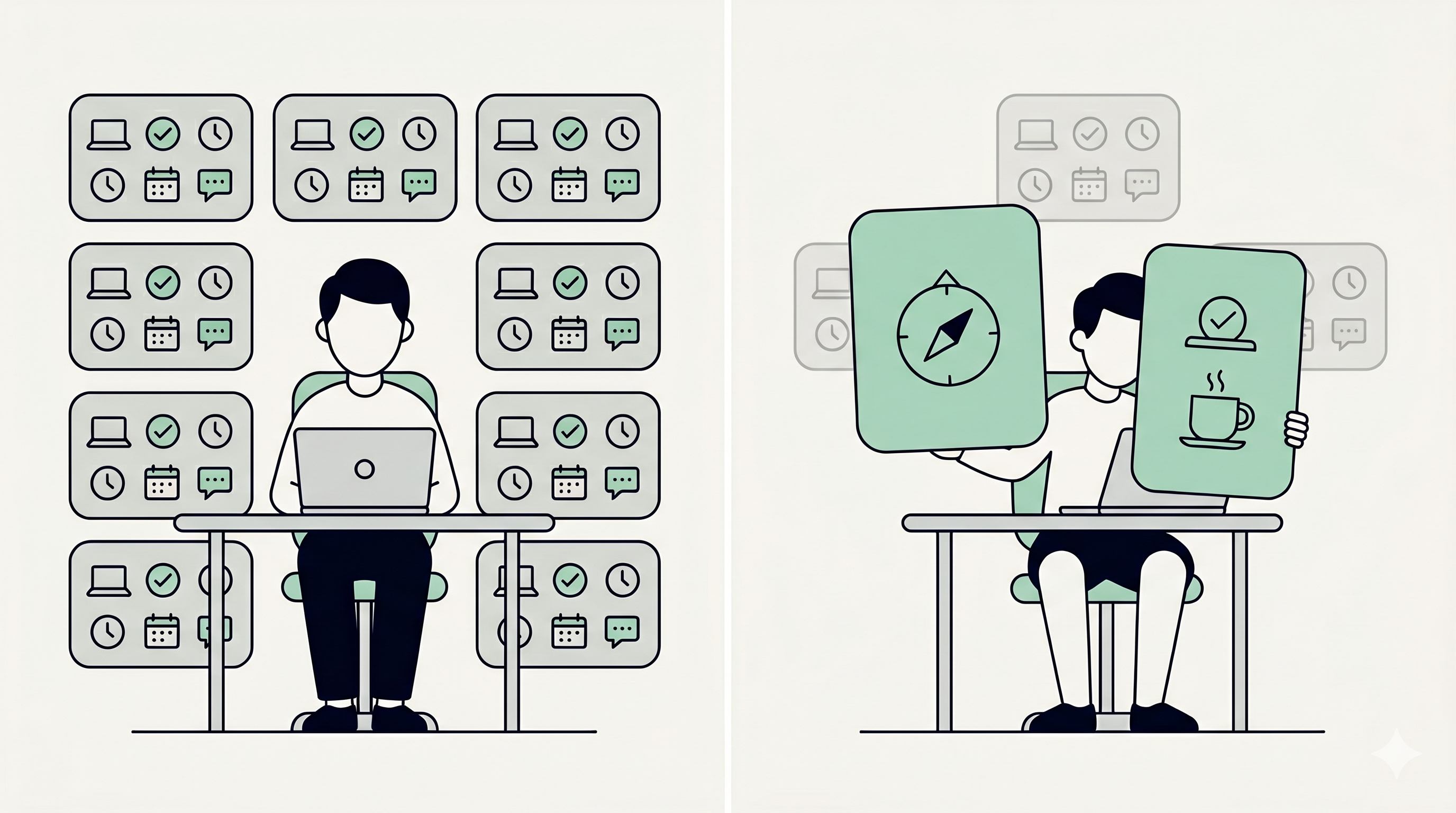
You're not angry. You're not crying in the bathroom. You're not writing passive-aggressive Slack messages. You're performing. You're showing up. You're doing the work.
And inside, something has gone quiet.
The part of you that used to get a small buzz from shipping a feature or closing a deal — it's not there anymore. In its place is a dull professionalism. You do the work because the work is there, not because you care. You open LinkedIn during lunch, scroll for 8 minutes, close it. You don't apply to anything. You don't know why.
If someone asked "how's work?" you'd say "fine." And you'd mean it. That's what makes this dangerous — "fine" doesn't set off any alarms.
This is what it feels like when you're quietly cracking.
The Diagnosis: The Catalyst
Quiet cracking is a term that describes workers who are performing well on the outside while silently disengaging on the inside. According to TalentLMS's 2025 study of 1,000 workers, 54% report experiencing some form of quiet cracking. One in five say it's a frequent or constant state. And research from McQuaid (2025) found that people who are quietly cracking are 6.2 times more likely to tip into full clinical burnout.
But here's what the research misses — and what we see in session after session:
Most people who are quietly cracking aren't stuck. They already know what they want. They're just not moving.
The Catalyst is Untangle's framework for the moment when you're not actually paralyzed by confusion — you're paralyzed by the weight of what acting would mean. You know you want to leave. You know the role isn't right. You know the team has changed. But moving makes it real, and real is scarier than numb.
This is the crucial difference between quiet cracking and burnout. Burnout is your body saying "I can't." Quiet cracking is your body saying "I won't — because then I'd have to deal with what comes next."
This is the same freeze we diagnosed in our piece on AI job anxiety — only instead of scrolling for answers, you've stopped looking entirely.
The data from McKinsey's April 2026 report confirms the trap: intent to quit among early-tenure employees has dropped to match long-tenure levels — not because people are happier, but because the job market is tight enough to keep them frozen. The cage door is technically open, but nobody's moving.
And that paralysis — the kind where you quietly crack instead of loudly leaving — is what we see more than anything else. It's the number one pattern behind career decisions that come to Untangle.
Your situation is different
Maybe you're cracking because your manager takes credit for your work and you've stopped caring enough to fight it. Maybe it's because the promotion you were promised got restructured away and nobody acknowledged it.
Those specifics change the move. Get the version written for your exact situation — takes 8 minutes.
Get your custom scriptHere's Your Move
Stop trying to answer "Should I stay or should I go?" — that question is too big and it's keeping you frozen.
Answer this one instead:
"If you could do anything for the next 12 months — same salary, no judgment — what would you choose?"
Not "what should I do." Not "what's realistic." What would you actually choose if the constraints disappeared for a moment?
This isn't a fantasy exercise. It's a diagnostic. Your answer tells you which direction your quiet cracking is pointing.
If your answer is "the same job but with a different manager" — your cracking is about the environment, not the work. The move isn't quitting. It's one conversation with HR or one internal transfer application. This week.
If your answer is "something completely different" — your cracking is about the path, not the place. The move isn't a two-year transition plan. It's one coffee chat with someone in that field. Not five. One.
If your answer is "I honestly don't know, just not this" — your cracking is real but the direction is unclear. The move is writing down what you liked about the last three projects that actually engaged you. The pattern is in the work you didn't have to force yourself to care about.
The Catalyst doesn't ask you to make the leap. It asks you to take the one step that makes the leap feel possible.
Yeah, But What If the Market Is Too Tight to Move?
This is the objection that keeps quiet crackers cracking for months. "The market is bad. Now isn't the time. I should be grateful I have a job."
Here's the problem with that logic: quiet cracking has a compounding cost. Every month you stay numb is a month your skills stagnate, your network goes cold, and your confidence erodes. You're not preserving your career by staying — you're slowly hollowing it out.
The Catalyst isn't "quit tomorrow." It's "send one message this week." The market being tight doesn't prevent you from having one conversation. It doesn't stop you from updating your LinkedIn headline. It doesn't block you from spending 30 minutes researching whether the thing you actually want exists.
The worst thing about a tight market is that it gives you a legitimate reason to do nothing. And doing nothing, when you're already cracking, is the most expensive thing you can do.
What Doing Nothing Costs You
- Identity: The longer you perform without caring, the more "person who doesn't care about their career" becomes who you are. That identity is harder to shake than any job market.
- Relationships: Quiet cracking doesn't stay at work. The numbness leaks into evenings, weekends, friendships. This numbness spreading beyond work hours is a version of the Split-Screen Trap — except now both screens are dimmed. People around you start getting the version of you that's left over after pretending all day — and it's not enough.
- Time: McKinsey's 2026 data shows that early-career workers are now staying as long as veterans — not by choice, but by default. If you're staying because you're frozen, not because you've chosen to stay, every month is a month you didn't choose.
The numbness spreading beyond work is a version of the Split-Screen Trap — except now both screens are dimmed.
Your Backup Plan
You have the conversation and nothing changes. You message one person in your dream field and they don't respond. You update your LinkedIn and the phone doesn't ring.
That's not failure. That's data.
The point of the Catalyst isn't to guarantee the outcome. It's to break the freeze. One action — even one that "fails" — changes your internal state from "I'm stuck" to "I'm in motion." And "in motion" is a fundamentally different identity than "cracking."
If the one coffee chat reveals that the dream field isn't what you imagined — great. You just saved yourself months of fantasizing. If the internal transfer conversation gets shut down — now you know the ceiling is real, not imagined, and you can plan accordingly.
When quiet cracking is triggered by a manager who crosses lines — like being asked to voluntarily resign with nothing in writing — the Catalyst still applies, but the first move looks different.
The Catalyst is designed to be low-risk and high-clarity. A small move that tells you something true.
The Reframe
Quiet cracking isn't a phase you'll naturally grow out of. "Fine" doesn't resolve itself. It calcifies.
The people who escape it don't do it by finding a better job on a job board. They do it by admitting — privately, honestly, without an audience — that they've already decided something needs to change. The decision happened weeks ago. Maybe months. The only thing missing is the first move.
You're not cracking because you're weak. You're cracking because you're strong enough to keep performing while something inside you is asking to be heard.
Listen to it. Not with a career plan. With one small action that matches what it's been telling you.
That's the Catalyst. Not the leap. The first step that makes the leap feel possible.
"They won't go all out but your app does." — Early tester
Quietly cracking at work? Facing a career decision you keep postponing?
Run your exact situation through Untangle and get your move in 8 minutes. 100% anonymous. No signup.
Get your moveFAQ: Quiet Cracking and Career Decisions
What is quiet cracking?
Quiet cracking is a workplace phenomenon where employees perform well externally while experiencing persistent internal disengagement and unhappiness. Unlike quiet quitting (intentionally doing less), quiet cracking happens to people who are still delivering — they've just stopped caring. TalentLMS research found 54% of workers experience it to some degree.
How is quiet cracking different from burnout?
Burnout is exhaustion — your body saying 'I can't do this anymore.' Quiet cracking is numbness — your body saying 'I won't engage with this anymore.' Burnout shows up in performance metrics. Quiet cracking hides behind good performance, which is why it's harder to detect and often more dangerous. People who are quietly cracking are 6.2 times more likely to develop full burnout.
What is the Catalyst framework for career decisions?
The Catalyst is a decision-making framework from Untangle for people who aren't actually stuck — they're avoiding the first move. The framework recognizes that the problem isn't confusion about what to do next. It's that acting on what you already know would make the dissatisfaction real, and real is scarier than numb. The fix is one small action that breaks the freeze.
Should I quit my job if I'm quietly cracking?
Not necessarily — and not yet. The first move isn't quitting. It's diagnosing what your cracking is pointing toward: is it the environment (same work, wrong team), the path (wrong work entirely), or unclear (you just know 'not this')? Each diagnosis leads to a different small action. One conversation, one application, one hour of research — not a resignation letter.
How do I stop quietly cracking?
Acknowledge that 'fine' isn't actually fine — that's the first step. Then ask yourself: 'If I could do anything for the next 12 months, same salary, no judgment, what would I choose?' Your answer reveals the direction. Then do the smallest version of that answer this week. The Catalyst approach says: one move that gives you clarity is worth more than months of performing on autopilot.